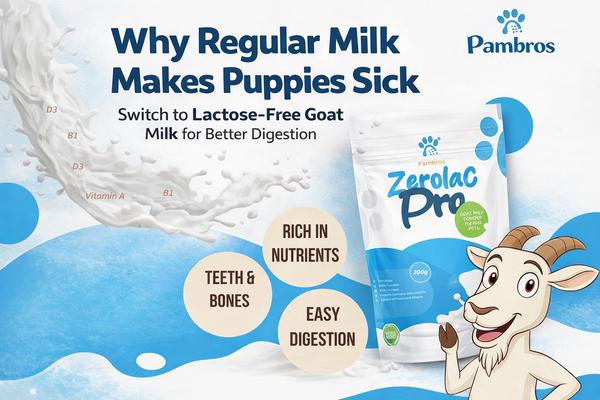
Goat milk powder can be a tasty, easy extra for dogs and cats, as long as you pick the right kind and feed it in sensible amounts. The key point is lactose: natural goat milk still contains it, so a lactose-removed powder is the gentler choice for most adult pets. Used as a topper or a drink alongside a complete diet, it adds flavour, moisture and a few useful nutrients.
Is goat milk lactose-free?
No. This is the most common mix-up. Natural goat milk contains only slightly less lactose than cow's milk, not "much less", so it is not a lactose-free option on its own.
Many adult dogs and cats produce less lactase, the enzyme that breaks down milk sugar, after weaning. For those pets, ordinary milk of any kind can lead to vomiting, diarrhoea, bloating or stomach pain.
Goat milk does have a slightly different make-up from cow's milk, with smaller fat globules and a different protein profile, which is why some owners find it sits better. But if lactose is the issue, the thing that really matters is whether the lactose has been taken out. For a fuller explanation, see our guide on whether goat milk is lactose-free.
What is lactose-free goat milk powder?
It is goat milk that has been dried into a powder and processed so the lactose is removed or broken down. It is still a dairy product: the milk proteins remain, so it is not suitable for pets with a milk protein allergy.
Powder keeps longer than fresh milk and you can make up just what you need.
How to choose a lactose-free goat milk powder
Not every goat milk powder is lactose-free, so read the label before you buy. Look for:
- "Lactose-free" or "lactose-removed" on the pack. Plain dried goat milk still contains nearly as much lactose as cow's milk.
- Made for pets. Choose a powder sold as a complementary food for dogs or cats, with a clear feeding guide by weight.
- A full ingredients list. You should be able to see exactly what has been added, such as probiotics, oils or vitamins.
- Clear allergen information. Check for milk, fish or anything else your pet reacts to.
Common myths about goat milk powder
- "All goat milk is lactose-free." It isn't. Only powders that have had the lactose removed can be called lactose-free.
- "Lactose-free means dairy-free." It doesn't. Milk proteins remain, so it is not suitable for a milk allergy.
- "It can replace a meal." It can't. It is an extra to feed alongside a complete, balanced diet.
What's in Pambros Zero-Lactose Goat Milk Powder?
Pambros Zero-Lactose Goat Milk Powder is a complementary food for dogs and cats. "Complementary" means it is designed to be fed alongside a complete diet, not instead of one.
It contains:
- Lactose-removed goat milk
- Probiotics (Lactobacillus and Bacillus), added to the formula
- Taurine, an amino acid cats need in their diet
- Fish oil and coconut oil
- Vitamins A, D3, E and B-complex
Allergen note: it contains milk (goat) and fish. If your pet has a known dairy or fish allergy, or you are running a food trial, check with your vet before using it.
Benefits of goat milk powder for pets
Goat milk powder is a food, not a medicine. What it can do:
Gentle on digestion
Because the lactose has been removed, it is designed to be gentler than ordinary milk for pets that don't handle dairy well. The added probiotics help support a healthy balance of gut bacteria as part of a balanced diet.
Supports skin and coat
Fish oil and coconut oil provide fats, and vitamins A and E help maintain normal skin and a healthy-looking coat.
Adds moisture to the diet
Mixed with water, it adds extra fluid to a meal. That can be handy for pets that eat mostly dry food or don't drink much, especially in warm weather. It does not replace fresh water, which should always be available.
Makes meals more appealing
Many dogs and cats love the taste. A little poured over kibble can tempt a fussy eater. If your pet suddenly goes off their food, though, that is a reason to see your vet rather than reach for a topper.
How to use goat milk powder
- As a drink: mix with warm (not hot) water, stir until smooth and serve fresh alongside meals.
- As a wet topper: pour the mixed milk over your pet's usual food.
- As a dry topper: sprinkle the powder straight over food. Make sure fresh water is close by.
- As frozen treats: freeze mixed milk in an ice-cube tray for a cooling summer snack. Count these in the daily amount.
Throw away any mixed milk your pet hasn't finished within a couple of hours, and keep the powder sealed in a cool, dry place.
Feeding guide: how much to give
Use the scoop that comes with the product. One scoop is 5 g. Feed once a day, based on your pet's weight:
| Pet's weight | Scoops per day | Water (if mixing) |
|---|---|---|
| Under 11 kg | 1 scoop (5 g) | 30 ml |
| 12–22 kg | 2 scoops | 60 ml |
| 23–34 kg | 3.5 scoops | 90 ml |
| Over 35 kg | 5 scoops | 120 ml |
A few tips:
- Introduce it gradually. Start with a small part of the full amount for the first few days and build up over about a week. This gives your pet's tummy time to adjust.
- Count it in daily calories. Goat milk contains fat and calories. Reduce your pet's main food slightly if needed so they stay at a healthy weight.
- Don't go over the guide. Too much can lead to loose stools.
Feeding cats
Most cats fall into the smallest band, so follow the under 11 kg amount: 1 scoop (5 g) in 30 ml of water, introduced slowly. If your cat is very small, elderly, or has a health condition, ask your vet how much to give.
Is it suitable for puppies and kittens?
Older puppies and kittens that are fully weaned and eating solid food can have it as a small, gradually introduced extra, at the amount for their weight.
It is not a puppy or kitten milk replacer. Very young or orphaned puppies and kittens need a proper milk replacer made for their species, which is formulated to meet their full nutritional needs. Ask your vet which to use. Our guide on lactose-free milk for puppies covers this in more detail.
Things to keep in mind
- Goat milk powder is an extra, not a complete meal. Keep feeding a complete, balanced diet.
- If your pet has a sensitive stomach, our guide to lactose-free milk options for dogs compares the choices.
- For a wider look at the pros and cons, read what vets think about goat milk for dogs.
When to see your vet
Speak to your vet before adding goat milk powder if your pet:
- has a known food allergy, especially to dairy or fish
- has pancreatitis, kidney disease or another condition that needs a special diet
- is overweight or on a weight-loss plan
- is a very young, orphaned, pregnant or nursing animal
Stop feeding it and contact your vet if your pet has vomiting, diarrhoea that lasts more than a day, itching or swelling after eating it, or seems unwell in any way. A sick pet needs a vet, not a supplement.
FAQs
Is goat milk better than cow's milk for pets?
Natural goat milk has only slightly less lactose than cow's milk, so neither is ideal for lactose-sensitive pets. A lactose-removed goat milk powder made for pets is the better option.
Can lactose-intolerant pets have goat milk powder?
A lactose-removed powder is designed for pets that don't handle lactose well. It still contains milk proteins, so it is not suitable for a milk allergy. Introduce it slowly.
Can I serve it dry?
Yes. You can sprinkle it over food or mix it with warm water. Always keep fresh water available.
Is it suitable for cats?
Yes. Pambros Zero-Lactose is a complementary food for dogs and cats and contains taurine. Follow the under 11 kg amount, or ask your vet if you're unsure.
Sources
- Blue Cross, Can dogs eat cheese? (Are dogs lactose intolerant?)
- PDSA, Vet Q&A: Can cats drink milk?
- Gut probiotics and health of dogs and cats, Microorganisms, 2023